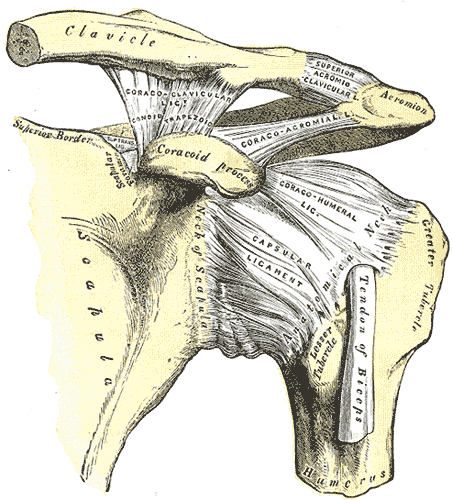
Acromioclavicular joint injuries are a common cause of shoulder pain, particularly following a fall, collision, or sporting trauma. The acromioclavicular joint, often referred to as the AC joint, sits on the top of the shoulder and connects the acromion (part of the shoulder blade) to the clavicle (collar bone). Despite being a relatively small joint, it plays a critical role in shoulder movement and force transfer through the upper limb.
The AC joint allows subtle but essential movement between the shoulder blade and collar bone as the arm lifts overhead, reaches across the body, or absorbs load through the arm. Because of this role, injuries to the AC joint can significantly affect daily activities, work tasks, and sporting performance.
Pain from the AC joint can occur gradually due to degenerative changes such as osteoarthritis. However, acute AC joint injuries are far more common and usually occur after trauma. These injuries range from mild ligament sprains to complete joint dislocations with obvious deformity. Physiotherapy is central to both the diagnosis and management of AC joint injuries, whether treated conservatively or following surgery.
This article focuses specifically on acute acromioclavicular joint injuries, their grading, and the role of physiotherapy in AC joint rehab and return to activity.
Key Facts
- Collision sports such as rugby league and Australian football have the highest rates of AC joint injury.
- Most Grade I and II AC joint injuries recover fully with physiotherapy and do not require surgery.
- Non-operative management of many Grade III injuries has outcomes comparable to surgery.
Risk Factors
- Participation in contact or collision sports
- Previous shoulder or AC joint injury
- Poor scapular control or shoulder strength
- Falls from height or speed
- Cycling and mountain biking
- Manual occupations requiring heavy lifting
Symptoms
- Pain over the tip of the shoulder
- Localised tenderness over the AC joint
- Swelling on the top of the shoulder
- Pain when lifting the arm
- Pain when moving the arm across the body
- Pain in the side of the shoulder or neck
- Visible deformity in higher-grade injuries
- Reduced shoulder strength and control
Aggravating Factors
- Lifting the arm overhead
- Reaching across the body
- Carrying heavy objects
- Lying on the affected shoulder
- Contact or collision activities
- Pushing or pulling movements
- Sudden loading through the arm
Causes
Acromioclavicular joint injuries are most commonly caused by direct or indirect trauma to the shoulder. The AC joint absorbs a significant amount of force when load is transferred through the upper limb, making it vulnerable during falls and collisions.
A direct impact often occurs when someone falls directly onto the point of their shoulder or is struck during contact sports such as rugby league. This force drives the acromion downward relative to the clavicle, stressing or tearing the stabilising ligaments.
An indirect mechanism occurs when falling onto an outstretched hand or elbow. In this scenario, force is transmitted up the arm to the AC joint, which absorbs the load and may become injured. If no clear traumatic mechanism is present, pain over the AC joint may originate from another shoulder structure, which is why physiotherapy assessment is essential.
How Is It Diagnosed?
Diagnosis of an acromioclavicular joint injury is primarily made through a clinical assessment by a physiotherapist or doctor. This includes taking a detailed history of the injury mechanism, onset of symptoms, and functional limitations.
Physical examination involves palpation of the AC joint, assessment of shoulder range of motion, strength testing, and specific stress tests to assess joint stability. Physiotherapists are trained to identify scapular dysfunction, muscle inhibition, and movement compensations that commonly occur following AC joint injury.
Imaging is not always required and is generally reserved for suspected higher-grade injuries or cases where symptoms are not progressing as expected.
Investigations & Imaging
- X-ray
- Used to assess joint alignment and identify dislocation or fracture
- MRI
- Used when soft tissue injury, ligament damage, or associated shoulder pathology is suspected
- Ultrasound
- May assist in assessing ligament integrity and associated muscle injury
Grading / Classification
- Grade I
- A mild sprain of the acromioclavicular ligament and joint capsule without tearing. The coracoclavicular ligaments remain intact, and normal joint alignment is maintained. There is no true dislocation of the AC joint. Clinically, this presents as localised pain and tenderness over the top of the shoulder, with discomfort during arm elevation or movements across the body, but no visible deformity or instability. X-rays are typically normal.
- Grade II
- A complete tear of the acromioclavicular ligament and joint capsule, with a sprain or partial injury to the coracoclavicular ligaments. The AC joint is disrupted but not fully dislocated, as the coracoclavicular ligaments still provide partial vertical stability. The clavicle may sit slightly higher than the acromion, creating a subtle step, but major displacement is not present. Symptoms are more pronounced than Grade I and include increased pain, swelling, tenderness, and pain with shoulder movement, particularly cross-body adduction.
- Grade III
- A complete rupture of both the acromioclavicular ligament and the coracoclavicular ligaments, along with disruption of the joint capsule. This results in a true dislocation of the AC joint, with the clavicle displaced superiorly relative to the acromion. Clinically, there is clear pain, swelling, and visible deformity at the top of the shoulder, often described as a step or bump. Vertical instability is present on examination, and imaging typically shows an increased coracoclavicular distance compared to the uninjured side. This grade commonly generates debate regarding surgical versus non-operative management.
- Grade IV
- A complete disruption of the acromioclavicular and coracoclavicular ligaments and capsule, with the distinguishing feature being posterior displacement of the clavicle into or through the trapezius muscle. This posterior displacement differentiates it from a Grade III injury. Clinically, the deformity may be more apparent when viewed from behind, and the injury is associated with significant pain, instability, and functional limitation. This injury pattern is considered unstable and typically requires surgical management.
- Grade V
- A more severe form of a Grade III injury, with complete rupture of the acromioclavicular and coracoclavicular ligaments and extensive disruption of the deltotrapezial fascia. This additional soft tissue damage allows the clavicle to appear markedly elevated relative to the acromion, producing an obvious deformity and drooping of the shoulder girdle. Pain and loss of function are significant in the acute phase, and imaging shows a substantially increased coracoclavicular distance compared to the opposite side. Surgical stabilisation is commonly recommended.
- Grade VI
- Rare and occurs following high-energy trauma. It involves complete rupture of the acromioclavicular and coracoclavicular ligaments and capsule, with the distal clavicle displaced inferiorly, typically beneath the acromion or coracoid. This displacement pattern is the defining feature of Grade VI injuries. Clinically, there is marked deformity and instability, often alongside other serious injuries. Due to the severity and instability of this injury, surgical management is almost always required.

Physiotherapy Management
Exercise
Physiotherapy for acromioclavicular joint injuries focuses on restoring pain-free shoulder movement, strength, and control. Early AC joint physiotherapy exercises aim to maintain gentle range of motion while protecting the healing ligaments. As pain settles, exercises progress to target scapular stability, rotator cuff strength, and shoulder endurance. Exercise progression is carefully graded to avoid excessive stress on the AC joint during healing.
Activity Modification
Physiotherapists provide tailored advice to reduce aggravating activities while avoiding unnecessary rest. Movements such as heavy lifting, cross-body loading, and contact activities are temporarily modified, while safe functional movement is encouraged to prevent stiffness and weakness.
Manual Therapy
Manual therapy may be used to address secondary stiffness in the shoulder or thoracic spine that develops after AC joint injury. Techniques are specific to restoring movement without placing stress through the injured AC joint.
Postural Retraining
Altered posture and scapular positioning are common following AC joint injury. Physiotherapy retrains shoulder blade positioning and upper limb mechanics to reduce ongoing joint stress and improve movement efficiency.
Bracing & Taping
Taping techniques may be used in early AC joint rehab to provide support and reduce pain during movement. Slings are used short term only when pain or instability is high, as prolonged immobilisation delays recovery.
Dry Needling
Dry needling may assist with pain and muscle guarding in surrounding muscles such as the upper trapezius and deltoid, always alongside active rehabilitation.
Education
Education is a cornerstone of physiotherapy for AC joint injuries. Understanding the injury, expected healing timelines, and safe loading principles helps reduce fear and supports long-term recovery.
Other Treatments
Pain-relieving medications may be used short term under medical guidance. In some cases, corticosteroid injections may be considered for persistent AC joint pain, although physiotherapy remains the primary treatment approach.
Surgery
Surgery is generally not required for Grade I and II acromioclavicular joint injuries.
Grade IV, V, and VI injuries typically require surgical stabilisation.
Management of Grade III injuries remains controversial and depends on factors such as joint instability, scapular dysfunction, occupation, and sporting demands. A specialist review is required to determine suitability for surgery.
Prognosis & Return to Activity
Prognosis depends on injury severity and adherence to AC joint rehab. Most people with low-grade injuries return to full activity within weeks. Higher-grade injuries and surgical cases require longer rehabilitation. Physiotherapists guide a graded return to work and sport, ensuring strength, control, and load tolerance have been restored.
Complications
- Persistent AC joint pain
- Chronic instability
- Cosmetic deformity
- Reduced shoulder strength
- Early onset AC joint osteoarthritis
Preventing Recurrence
- Improving shoulder and scapular strength to protect the AC joint
- Using protective padding in contact sports
- Gradual return to sport after injury
- Avoiding high-risk falls where possible
- Early physiotherapy management after shoulder trauma
When to See a Physio
- Shoulder pain after a fall or collision
- Pain on the top of the shoulder
- Difficulty lifting the arm
- Visible shoulder deformity
- Ongoing pain beyond a few days
- Planning return to sport or work